Sharaa’s Balancing Act: Syria Between War, Isolation and Reconstruction
An analysis of Ahmed al-Sharaa’s balancing strategy in Syria’s reconstruction phase amid sanctions, diplomacy, and great-power competition.
Syrian President Ahmed al-Sharaa, whose primary goal is to move Syria out of its seemingly endless period of war and isolation, is trying to lead the country into a new phase of restarting the state and rebuilding society.1 European states, while an indispensable factor in Syria’s reconstruction, are still constrained by security and political conditions that threaten the normal functioning of investments.2 “In a recent France 24 report from Damascus, the channel explored this dilemma in detail.” The France 24 video captures this tension well: it highlights Syria’s economic policy for reconstruction, the easing of sanctions that have posed major obstacles to rebuilding the country, and how external diplomatic engagements have turned into a central tool in Syria’s struggle to build future prosperity.
Sanctions, Legitimacy and Sharaa’s Strategy
Since 2025, the United States and the European Union have gradually lifted broad economic sanctions, taking Syria’s future into account, while preserving targeted, security-focused restrictions.3 Syria is trying to re-legitimize itself by establishing high-level diplomatic relations with Europe, the US, Gulf countries and international investors.4 I think the reason Sharaa keeps the same distance from everyone and effectively flirts with every country is that, in Syria’s reconstruction phase, he wants the country to develop without being dependent on any state and does not want to be illegitimately tied to anyone’s patronage.
Because Syria has just come out of war, it is extremely worn down and about 70% of its people are struggling with poverty.5 In this context, it is quite difficult for Syria to escape poverty without entering under the wing of states like America, Russia, or even Turkey. That is why Sharaa aims to achieve development without being dependent on anyone, by not cutting ties with any actor. For example, he does not want Russia’s military bases to be completely pushed out of the region; he wants Russia’s presence to remain in Syria, even if only a little.6 Meaning that signalling Russian air and naval bases will remain operational under revised arrangements rather than being fully expelled, with Moscow and Damascus publicly discussing a possible “reformatting” of Russia’s military facilities in Syria.7 I base this opinion on what I think is a tactical answer he gave to a question in his own interview.
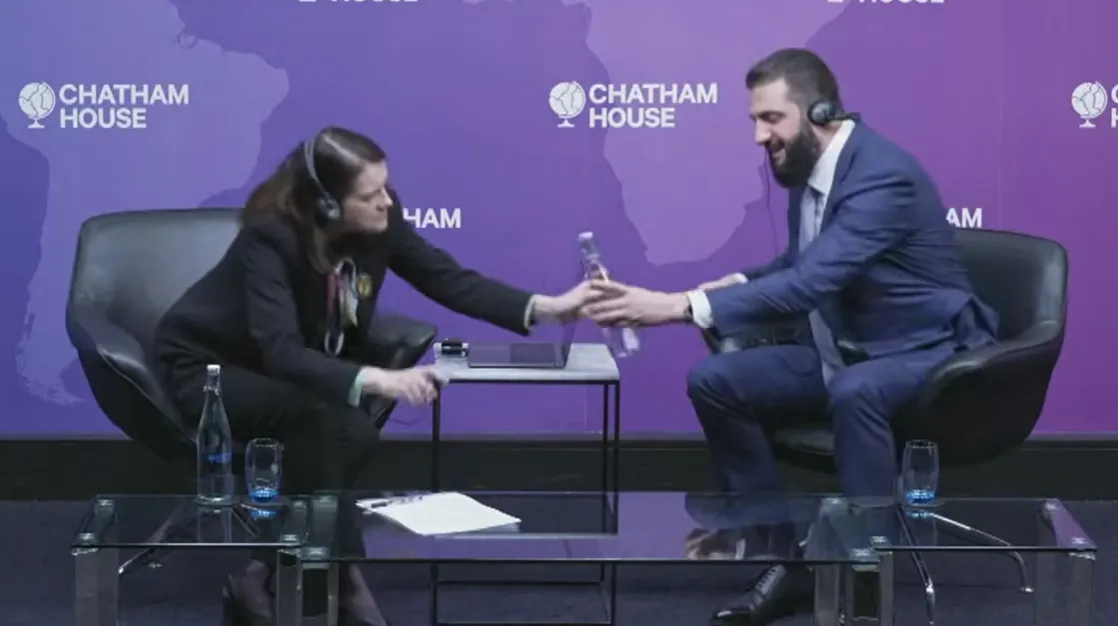
When Sharaa is asked, “What will your future policies be regarding Russian bases?”, exactly as this question is posed he reaches for a water bottle.8 Sharaa cannot open the bottle and has the reporter open it. I personally see this less as a simple mistake than as something done deliberately, possibly a brilliant move designed to make people forget the weight of the question in the media. A man who has fought for decades on the battlefield, whose hand has held a gun for years, not being able to open a water bottle may seem funny, ridiculous, or even sympathetic to some people because of his reaction. After this incident, I did not see the question he was asked during the interview being seriously discussed even once in the media. What is much more visible is that people and the media keep sharing this moment itself.
Sharaa then answers the question by joking that his recent back-to-back visits to the White House and the Kremlin are an indication that “Syrian diplomacy is active,” while acknowledging how difficult it is to maintain a perfect balance between conflicting global powers.9 In my opinion, this is another move done deliberately, and it strongly supports the policy of not being dependent on anyone that I mentioned earlier. He is signaling a strategy of balance: engaging Washington and Moscow at the same time, avoiding full alignment with either camp, and preserving as much autonomous room for maneuver as possible.
Europe Moves to the Center of Reconstruction
European states, and the EU as a bloc, have now become key political and normative actors in Syria’s reconstruction, even as Gulf capital drives much of the early investment.10 The EU’s lifting of economic sanctions has opened the way for access to European financial markets, credit, and trade opportunities that Syria needs for a comprehensive rebuilding process. Macron’s landmark visit to Damascus symbolises Europe’s broader desire to re-engage with Syria. “But, this re-engagement is tied to conditions related to stability, governance, and human rights.11 Europe is not just bringing money; it is also bringing its own political and normative framework, which inevitably shapes what kind of reconstruction will be possible.
Syria’s New Economic Narrative
Against this backdrop, Syrian officials talk about a “guided free-market economy,” where the private sector is meant to take the lead but the state steps in when necessary to correct imbalances.12 The government is trying to put forward “bankable projects” and clear, stable rules in order to lower investor risk and offer more predictable returns.13 The authorities also stress listening to the private sector, increasing domestic production, and using Syria’s strategic geography as a hub for trade and connectivity.14 Taken together, this is an attempt to sell Syria as both a reforming state and a profitable frontier market: a place where investors can make money, but under a political leadership that remains firmly in control.
Gulf Money, Cautious Europe
On the financial side, UAE and Saudi investors have already announced multi-billion-dollar packages in energy, aviation, property, and telecoms.15 Major business figures such as Emaar’s founder Alabbar are publicly exploring massive investment pledges in Syria.16 European firms, by contrast, are more cautious, weighing security risks and governance concerns even as diplomatic ties are normalized.17 So while Gulf capital seems willing to move faster, European capital brings more conditions and hesitations—another element Sharaa has to balance in his wider strategy.
Reconstruction as Geopolitics
Finally, reconstruction itself has turned into a new arena of strategic competition between Europe, the US, Russia, Iran and the Gulf states.18 European involvement can act as a counterweight to Russian and Iranian influence, but it also pulls Syria more firmly toward Western political and economic standards.19 Investment agreements often function as political signals: whoever builds Syria’s airports, telecom networks and energy grid will play a decisive role in shaping the country’s long-term alignments.
In sense, Sharaa’s bottle moment, his visits to both the White House and the Kremlin, his insistence on “guided” markets and diversified partners—all of them can be read as pieces of the same puzzle. He is trying to rebuild a devastated country, attract money from every direction, and at the same time avoid falling fully under the shadow of any single power. Whether this non-aligned, carefully balanced strategy can survive the harsh realities of poverty, security threats and great-power rivalry is exactly the question that will define Syria’s reconstruction in the years ahead.
Notes
Footnotes
-
“President al-Sharaa Sets State-Building Priorities and Reconstruction Agenda,” Syrian Arab News Agency (SANA), March 5, 2026. ↩
-
“Syria’s ‘Security Challenges’ Main Obstacle to Attracting Investors,” France 24, July 7, 2026. ↩
-
“European Union Lifts Economic Sanctions on Syria,” Deutsche Welle (DW), May 28, 2025. ↩
-
“Syrian President Unveils Reconstruction Roadmap During Meeting with Macron,” Anadolu Agency, July 7, 2026. ↩
-
“The Impact of Sanctions on the Humanitarian Situation in Syria,” European Parliamentary Research Service, Briefing 749765, 2023. ↩
-
“FULL REMARKS: Syrian President Ahmed al-Sharaa Outlines Vision for Syria at Chatham House,” DWS News (YouTube), March 30, 2026. ↩
-
“Russia Says It Is Discussing ‘Reformatting’ of Military Facilities in Syria,” Reuters, June 10, 2026. ↩
-
Ibid. ↩
-
Ahmed al-Sharaa, “Syria’s New Horizon: Rebuilding as a Model for Global Cooperation,” keynote at Future Investment Initiative (FII9), October 28, 2025, video. ↩
-
“EU Grants Syria $722 Million for Recovery, Humanitarian Aid, von der Leyen Says,” Reuters, January 9, 2026. ↩
-
“Bomb Attacks Wound 18 in Damascus as Macron Visits,” France 24, July 7, 2026. ↩
-
“Syria’s Economic Reset: Investments, Reforms and a New Strategic Direction,” National Law Review, Jan 29 2026. ↩
-
“Syria Must Offer Predictability and ‘Bankable Projects’ to Boost Foreign Investment,” The National, June 1, 2026. ↩
-
“Syria and Saudi Arabia Sign Multibillion-Dollar Investment Deals,” Al Jazeera, February 7, 2026. ↩
-
Ibid. ↩
-
“Syria Must Offer Predictability and ‘Bankable Projects’ to Boost Foreign Investment,” The National, June 1, 2026. ↩
-
“Charting a Strategic Path for Syria’s Post-War Reconstruction,” Atlantic Council, July 16, 2025. ↩
-
Erwin van Veen, Sanctions, Governance and Reconstruction in Syria, Clingendael Institute Policy Brief, April 2025. ↩
-
Dr. Muriel Asseburg, “Reconstruction in Syria: Challenges and Policy Options for the EU and its Member States,” July 19, 2020. ↩