Why Does Turkey Prefer for Iran to Remain a Weak State?
A neorealist analysis of Turkey's regional strategy toward a weakened Iran, examining Syria, the South Caucasus, Iraq, and energy competition.
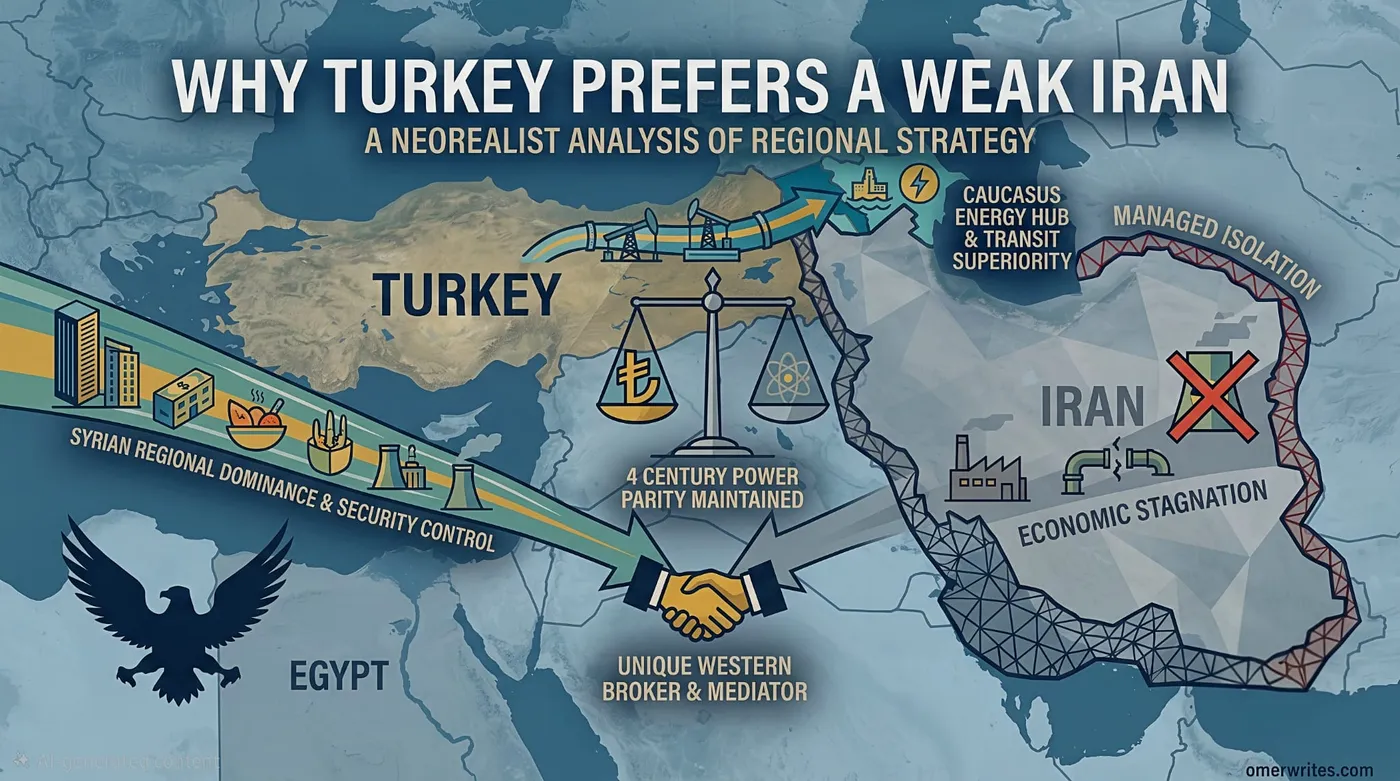
From a Neorealist balance‑of‑power perspective, Turkey tries to keep Iran from becoming a regional hegemon. The regional competition between Ankara and Tehran is not merely a product of opportunistic maneuvers but a structural imperative; Turkey’s strategic preference for a weakened Iran reflects a desire to consolidate its own regional influence while avoiding both an overpowering Iran and a destabilizing collapse in Iran’s state capacity. The Middle East has recently been the scene of tensions that cannot be underestimated, driven particularly by direct clashes between Iran and Israel and ongoing issues between the United States and Iran. The profound transformation following the collapse of the Bashar al‑Assad regime in Syria in December 2024, and the resulting shift in regional balances, has brought a critical question to the fore: Why does Turkey prefer its neighbor Iran to remain a weak state rather than a powerful one? This article argues that the Republic of Turkey prefers the Islamic Republic of Iran to remain a weakened state with diminished regional prestige rather than a strong, dominant power; it posits that Turkey views the curtailing of Tehran’s power as essential to securing its own strategic superiority, cross‑border security, and regional leadership.
Syria: Iran Lost Everything, Turkey Took Over
Dethroned President Bashar al-Assad’s fall and Turkey’s rapid move into Syria reflect Ankara’s attempt to convert Iran’s sudden loss of strategic depth into a lasting shift in the regional balance of power in its favor. For a long time, Iran sought to bring Syria under its influence and draw it firmly into the “Axis of Resistance” coalition. When al‑Assad was overthrown in December 2024, Iran lost the time and money it had invested for years. Turkey, wasting no time, stepped in and replaced Iran as the dominant power.
Brian Katulious, put it bluntly: “The fall of the Bashar al‑Assad regime in Syria marks the end of the greater Iranian project in the Levant for the foreseeable future.”1 He noted that Iran had invested a great amount of energy and resources over the past decade to maintain its military presence in Syria, which is a presence that enabled the Islamic Revolutionary Guard Corps (IRGC) to move weapons into Lebanon and the West Bank. The sudden loss of Assad, Brian argued, “upends the core assumptions and ideas that have long underpinned Iranian strategy in the Middle East.”2 These underpinned assumptions included the belief that Tehran could permanently maintain a contiguous geopolitical corridor. Stretching from Baghdad to Beirut through Damascus, to project power into the Levant. Iran had implemented its policies based on the notion of relying on proxy networks, such as Hezbollah and various Shiite militia groups. They would be enough to secure regional dominance and counter adversaries without engaging in direct conventional warfare. Assad’s sudden collapse shattered this assumption, revealing that state-level support is irreplaceable and proved that the strategic depth Iran had cultivated over decades could vanish overnight.
Turkey moved fast. Following Assad’s collapse, Ankara immediately secured agreements with the new Syrian transitional government led by Ahmad al‑Sharaa. al-Sharaa was historically known by his nom de guerre “Abu Mohammad al-Julani”. He was a former leader of the al-Qaeda linked al-Nusra Front, and once had a $10 million U.S. bounty on his head. His transformation from a globally designated militant into a suit-wearing statesman emphasizes the profound fluency of the new Syrian politics. A February 2025 report by Special Eurasia documents that Turkey has negotiated a joint defense pact, including the establishment of Turkish military bases at Palmyra and the T4 airbase in Syria’s central desert, as well as expanded access to Syrian airspace.3 President Trump also had comments on Ankara’s, specifically Erdogan’s position in Syria.
The Foundation for Defense of Democracies reported that Trump told Erdogan directly: “You’ve taken it over through surrogates.”4 Chatham House (2025), in its paper “The Shape‑Shifting Axis of Resistance,”5 noted that Iran’s networks, despite significant setbacks in 2024 and 2025, have shown historical resilience. The story is not over for Iran. But the balance has clearly shifted. Typically, a rapid military expansion of Turkish military and defense pacts in the Levant might trigger strategic friction with Western allies. However for both U.S. and Israeli strategic interests, a Syria stabilized under Turkish influence, even through complex local actors, represents a net positive as it effectively seals the collapse of Iran’s land corridor to the Mediterranean.
The South Caucasus: Turkey Grows, Iran Shrinks
Turkey and Iran historically have been locked in a competition for influence in the Caucasus, especially over Azerbaijan and Armenia. Turkey’s support for Azerbaijan and Iran’s strategic anxiety over the Zangezur Corridor illustrate competitive balancing behaviour: each side adjusts its alliances and corridors to prevent the other from consolidating regional dominance.
The Gulf International Forum (2023), in Unseen Tensions: Undercurrents of Iran‑Turkey Relations in the South Caucasus, wrote that “the age‑old rivalry would be recognizable to strategists in the Ottoman and Safavid Empires.”6 The analysis explains how Turkey helped Azerbaijan secure decisive military dominance over Armenia in the Nagorno‑Karabakh War (2020), and again assisted Baku in September 2023. These moves, the Forum noted, “largely came at the expense of Iran, which has been constrained in Central Asia and the Caucasus.”7
Academic record backs this up. The Journal of Iran and Central Eurasia Studies published a peer‑reviewed article by M. J. Javadi Arjmand titled “Iran and Turkey in the South Caucasus: Competition and Cooperation,”8 arguing that the post–Cold War power vacuum shaped the pattern of rivalry between the two states. The 2017 book The Great Game in West Asia: Iran, Turkey and the South Caucasus put it clearly: “Both have sought to deepen their regional influence and power, and in the South Caucasus each has achieved a modicum of success.”9
More recently, a 2024 article in a Russian international relations journal — “How Iran Perceives Turkey’s Rise in the South Caucasus,”10 by Golmohammadi and Markedonov — examined Iran’s growing strategic anxiety over Azerbaijan, noting that “Turkey and Israel’s growing influence in alliance with Azerbaijan” expanded sharply after 2020. A 2023 CACIANALYST.org analysis goes further, documenting Iran and Russia’s disagreements over the Zangezur Corridor and Tehran’s mounting concerns over the Turkey–Azerbaijan relationship.
Iraq: Two Corridors, One Winner
Iran’s sanctions‑driven weakness in energy transit reinforces a Neorealist pattern in which Turkey uses economic leverage to lock in favourable relative gains. Turkey and Iran are also in direct competition over political influence in Iraq — and the stakes are massive.
Turkey’s Development Road project begins at the Persian Gulf and aims to turn Turkey into a bridge between Europe and the Middle East, running a 1,200 km twin rail‑and‑road corridor from the Grand Faw Port north to the Turkish border. It stands directly opposed to Iran’s land‑bridge ambitions. Iran’s own corridor strategy is about securing regional hegemony and building a “forward defense” line against Israel and the United States — moving the battlefield, via proxy networks, toward the Mediterranean coast and Israel’s borders rather than fighting on Iranian soil.
A peer‑reviewed article on Dergipark (August 2024), “Türkiye’s Strategic ‘Development Road’ Project: Geopolitical Impacts and Regional Opportunities,”11 presents the Development Road as a strong alternative to both China’s Belt and Road Initiative and the US‑led India–Middle East–Europe Economic Corridor (IMEC), arguing Turkey can become the key Eurasian transit point.
Multiple sources confirm Iran sees this as a direct threat. The Arab Center DC (2025) stated plainly that “several countries have the ability to disrupt Iraq’s plans, notably Türkiye, Iran, and Kuwait.”12 An XCEPT Research paper (2024) described the project as “an Iraqi project seeking to create a road and railway infrastructure connecting the Persian Gulf with Türkiye through Iraq”13 — and confirmed that Iran is among the countries most likely to work against it. Al‑Majalla (2024) positioned the Development Road as a direct competitor to the Suez Canal and Iran’s land‑based routes.
Energy: Turkey Wants to Be the Hub Iran Cannot Be
Turkey’s strategic goal is to become an energy hub connecting Central Asia, the Middle East, and Europe. Sanctions on Iran — combined with Iran’s internal crises and corruption — have created exactly the kind of economic weakness that prevents Iran from competing for that role.
A peer‑reviewed study in Heliyon (NIH/PubMed, 2023), titled “Turkey’s Quest to Become a Regional Energy Hub: Challenges and Opportunities,”14 analyzed Turkey’s energy ambitions and its geographic advantage: lying “between energy‑rich areas of the Middle East and energy‑consuming Europe”15 and pursuing pipeline transit revenues. CESRAN International’s paper “Turkish Natural Gas Hub and Energy Security”16 was direct about the competition, stating that “Egyptian, Iranian, as well as Iraqi gas should be taken on board in scrutinising Turkish energy hub ambitions”17 Explicitly naming Iran as a competing source Turkey must account for.
While analyses from institutions such as AEI, FDD, and the Orion Policy Institute inherently reflect US and allied security paradigms, their underlying strategic assessments accurately illustrate the geopolitical void Ankara seeks to capitalize on. The numbers tell the same story. The IRAM Center, citing official Turkish Statistical Institute (TSI) data, shows that Turkey–Iran trade volume dropped to 3.4 billion USD in 2020. Its lowest level in seven years — after the United States re‑imposed sanctions following its 2018 JCPOA withdrawal. That was a 42% drop from the 2017 baseline.18 Turkish exports to Iran fell 18% in a single year. Iran’s sanctions‑related weakness, in other words, reshapes the trade relationship entirely on Turkey’s terms.
The Orion Policy Institute (2024) confirmed in “Iran–Turkey Partnership: Energy, Trade, and Sanctions Evasion” that while “Turkey is a primary exporter of manufactured goods for Iran and is used as a trade route for Iranian goods to Europe,”19 US sanctions have significantly reduced Iran’s capacity to act as an independent energy player.
Turkey’s Most Underrated Advantage: Being the Only Broker
By keeping Iran weak yet functional and reliant on Turkish mediation, Ankara engineers a managed imbalance: Iran cannot overturn the four‑century power parity, but remains too important to be ignored.
Ankara holds unique contacts inside Iran that no other Western‑allied state has. A weakened, sanctioned Iran that cannot build alliances elsewhere makes Turkey irreplaceable as a broker between Tehran and the West.
The Atlantic Council (March 2026) published “Could Turkey Help Mediate an End to the Iran War?”20 — documenting Turkish Foreign Minister Hakan Fidan’s direct outreach to Iranian, Egyptian, EU, and US officials during the 2025–2026 Iran crisis. Ankara’s stated goal, the Council noted, is “regional ownership”21 of security. The Washington Institute for Near East Policy (May 2026), in “Turkey’s Limited Role in the Iran War,” was even more direct: “Turkey does not want to see a nuclear Iran next door, given that such a development would undoubtedly end the four centuries of power parity between the two states.”
That last line captures Turkey’s position perfectly. Not an Iran that is destroyed. Not an Iran that goes nuclear. An Iran that stays weak, stays stable, and keeps needing Turkey.
In summary, Turkey’s geopolitical strategy regarding Iran seeks neither a total collapse nor a regional hegemon that has attained nuclear power. For Ankara, the ideal scenario about Iran is the scenario where Iran remains weak, yet retains an international presence. This fragile balance affords Turkey two significant advantages: first, it allows it to maintain the role of a crucial bridge between Tehran and the West; second, it protects the long-standing balance of power that has existed for four centuries. Ultimately, by transforming its neighbor’s weakness and isolation into direct geopolitical leverage, Turkey strengthens its own regional influence.
Notes
Footnotes
-
Brian Katulis, “The Reshaping of Iran’s Axis of Resistance,” American Enterprise Institute, January 30, 2025, https://www.aei.org/articles/the-reshaping-of-irans-axis-of-resistance/. ↩
-
Katulis, “The Reshaping of Iran’s Axis.” ↩
-
Special Eurasia. (2025, February 6). Syria: Turkey’s Increasing Influence and Military Presence. SpecialEurasia. https://www.specialeurasia.com/2025/02/06/syria-turkey-military-base/ ↩
-
Foundation for Defense of Democracies, “Turkey’s Rising Influence in Post-Assad Syria,” Foundation for Defense of Democracies, April 10, 2025, https://www.fdd.org/analysis/policy_briefs/2025/04/10/turkeys-rising-influence-in-post-assad-syria/. ↩
-
Renad Mansour, Hayder Al-Shakeri, and Haid Haid, “The shape-shifting ‘axis of resistance’: How Iran and its networks adapt to external pressures,” Chatham House, March 6, 2025, https://www.chathamhouse.org/2025/03/shape-shifting-axis-resistance. ↩
-
Gulf International Forum, “Unseen Tensions: Undercurrents of Iran-Turkey Relations in the South Caucasus,” Gulf International Forum, https://gulfif.org/unseen-tensions-the-undercurrents-of-iran-turkey-relations-in-the-south-caucasus/. ↩
-
Gulf International Forum, “Unseen Tensions.” ↩
-
M. J. Javadi Arjmand, “Iran and Turkey in the South Caucasus: Competition and Cooperation,” Journal of Iran and Central Eurasia Studies 1, no. 1 (2018): 15–31, https://jices.ut.ac.ir/article_69187.html. ↩
-
Arjmand, “Iran and Turkey in the South Caucasus,” 15–31. ↩
-
Vali Golmohammadi and Sergey M. Markedonov, “How Iran Perceives Turkey’s Rise in the South Caucasus,” Russia in Global Affairs 22, no. 1 (January/March 2024): 152–175, https://eng.globalaffairs.ru/articles/iran-and-turkeys-rise/. ↩
-
Serkan Tezel, “Türkiye’s Strategic ‘Development Road’ Project: Geopolitical Impacts and Regional Opportunities,” Journal of Balkan and Near Eastern Studies (or relevant Dergipark Journal, August 2024), https://dergipark.org.tr/en/download/article-file/4016636. ↩
-
Arab Center Washington DC, “Iraq’s Development Road Project: Geopolitical Challenges and Regional Implications,” Arab Center Washington DC, 2025, https://arabcenterdc.org/. ↩
-
XCEPT Research, “The Iraqi Development Road: Infrastructure, Connectivity, and Regional Rivalries,” Cross-Border Conflict Evidence, Policy and Trends (XCEPT), 2024, https://www.xcept-research.org/. ↩
-
Aliaksandr Novikau and Jahja Muhasilović, “Turkey’s Quest to Become a Regional Energy Hub: Challenges and Opportunities,” Heliyon 9, no. 11 (November 2023): e21535, https://www.sciencedirect.com/science/article/pii/S2405844023087431. ↩
-
Aliaksandr Novikau ve Jahja Muhasilović, “Turkey’s Quest to Become a Regional Energy Hub: Challenges and Opportunities,” Heliyon 9, no. 11 (Kasım 2023): e21535, https://www.sciencedirect.com/science/article/pii/S2405844023087431. ↩
-
Volkan Özdemir, “Turkish Natural Gas Hub and Energy Security,” Political Reflection Magazine 3, no. 3 (August 2017): 33–38, https://cesran.org/wp-content/uploads/2017/08/TURKISH-NATURAL-GAS-HUB-AND-ENERGY-SECURITY.pdf. ↩
-
Cesran International, “Turkish Natural Gas Hub and Energy Security,” Cesran International, https://cesran.org/. ↩
-
“The Adverse Effects of the Trade Sanctions between Turkey and Iran,” İRAM Center (citing official Turkish Statistical Institute [TSI] dataset), https://iramcenter.org/en/the-adverse-effects-of-the-trade-sanctions-between-turkey-and-iran_en-389. ↩
-
Orion Policy Institute, “Iran-Turkey Partnership: Energy, Trade, and Sanctions Evasion,” Orion Policy Institute, January 30, 2024, https://orionpolicy.org/iran-turkey-partnership-energy-trade-and-sanctions-evasion/. ↩
-
Alper Coşkun, “Could Turkey Help Mediate an End to the Iran War?” TurkeySource (blog), Atlantic Council, March 11, 2026, https://www.atlanticcouncil.org/blogs/turkeysource/could-turkey-help-mediate-an-end-to-the-iran-war/. ↩
-
Matthew Bryza, “Could Turkey help mediate an end to the Iran war?” TURKEYSource, Atlantic Council, March 31, 2026. ↩